
Overtaking in the Rain
Formula 1 legend Ayrton Senna once said: 'You cannot overtake 15 cars in sunny weather, but you can when it's raining.' These times of COVID-19-induced economic hardship are 'bad weather' only a few were prepared for. The obvious question that is currently grappling everybody's mind is how can we utilize this extremely challenging situation in a positive and value-creating way for our business? What sets the companies which emerge strengthened from such crisis apart from the rest?
Looking at the most recent crisis - the subprime crisis - reveals a clear pattern: Start-ups fare well in these circumstances. Several companies founded in 2008 and 2009 are among the most successful new businesses of the past decade. These now-famous companies defied the adverse economic conditions and challenged incumbents in their respective markets. Up to this point, they have amassed combined funding of ~35bn USD – equal to the entire GDP of Bahrain or Bolivia.
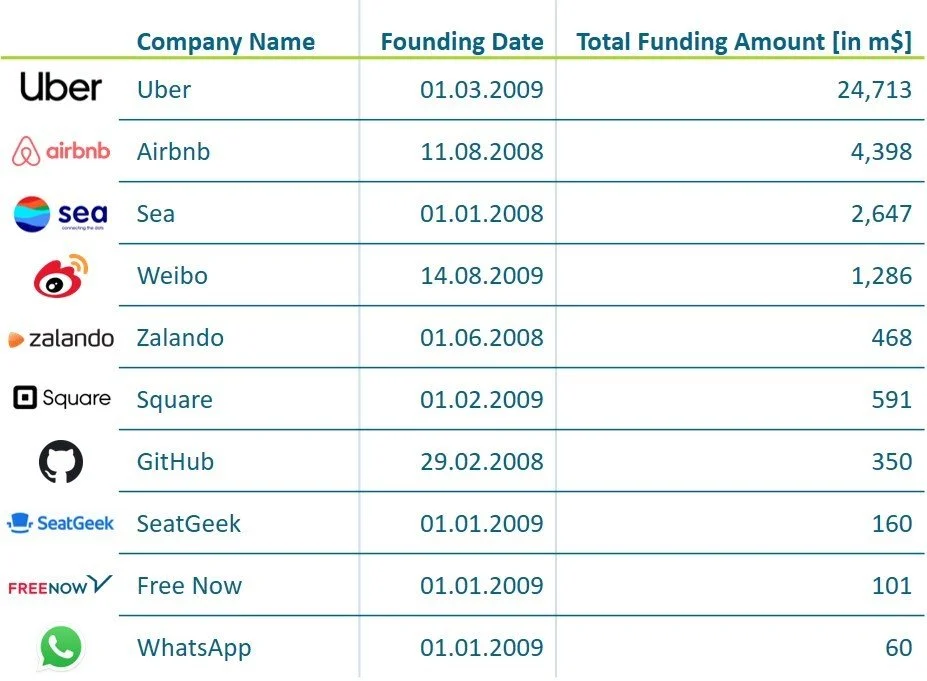
Selected ventures from vintages 2008 and 2009
For many successful start-ups of that era, the crisis was a two-edged sword. The economic recession made it difficult to secure investor funding, and customers' willingness to pay for innovative services dwindled. Nevertheless, the crisis-infused disruption in the market and employment conditions acted as a catalyst for many start-ups.
Take Airbnb and Uber as an example: the large spikes in unemployment and the need to save money at every corner such as transport or holiday provided these two companies with ideal market conditions for their business model. Customers were able to save money compared to traditional competitors' offerings, while drivers and hosts respectively could gain significant additional income. Similarly, WhatsApp enabled people to save money during a time where most people still paid per text message. Hence, these start-ups' success is not just a mere coincidence but a result of them addressing the economic needs elevated by the crisis.
Another critical factor has been the lean start-up approach based on customer focus and iterative, agile product development. It allowed start-ups to mitigate financial bottlenecks and advance their innovations very efficiently. This quality propelled the most successful start-ups on eye-level with or even beyond incumbents within just a decade.
So how can established organizations put on the rain tyres to emerge stronger from the crisis? We have compiled four lessons learned from our work. Apply them to your business like a set of rain tyres to gain traction and speed.
1) Cross-everything teams
Heterogenous, well-balanced teams deliver better results. When team members cover all the steps of the process or value chain, the solution has better chances of working end-to-end.
2) Agile development and design thinking
Beyond the buzz, those working practices centered around the customers and an iterative, hypothesis-, and data-driven project execution deliver a performance increase of at least 40%.
3) Staged funding
Overfunded projects tend never to find product-market-fit. Strictly staged funding linked to objectively measurable goals provides teams with focus. Initial funding should not cover more than three months runway, with periods rising to one year in later stages. Reporting on the operational KPIs should be available weekly.
4) Accountable ownership
One key reason for lean start-ups to thrive is the commitment of the management team. Established organizations cannot match the financial upside nor the daunting threats that venture founders face. But they can increase accountability, for instance by creating ownership in addition to the operational responsibility on a sponsor level and by frequent as well as transparent communications.
Extra tyre: Modern technology stack
A service-oriented architecture with micro-services loosely coupled by APIs is much more flexible than traditional set-ups. Add the partnering capabilities to quickly find the right partner for the development challenge at hand and technology becomes a booster instead of a drag.
This works for initiatives to increase efficiency as well as for new business projects. Look out to leverage your CDO organization or Digital Transformation teams, as they have ample experience with these practices.
Thanks to Marc Buchner and Conrad Bethge who contributed to this article.
