Overtaking in the Rain
Economic downturns act as a catalyst for disruption. A look at the structural reasons why startups outperformed incumbents during the subprime crisis, and how established organizations can replicate that speed through cross-functional teams and staged funding.
Formula 1 legend Ayrton Senna once said: 'You cannot overtake 15 cars in sunny weather, but you can when it's raining.' These times of COVID-19-induced economic hardship are 'bad weather' only a few were prepared for. The obvious question that is currently grappling everybody's mind is how can we utilize this extremely challenging situation in a positive and value-creating way for our business? What sets the companies which emerge strengthened from such crisis apart from the rest?
Looking at the most recent crisis - the subprime crisis - reveals a clear pattern: Start-ups fare well in these circumstances. Several companies founded in 2008 and 2009 are among the most successful new businesses of the past decade. These now-famous companies defied the adverse economic conditions and challenged incumbents in their respective markets. Up to this point, they have amassed combined funding of ~35bn USD – equal to the entire GDP of Bahrain or Bolivia.
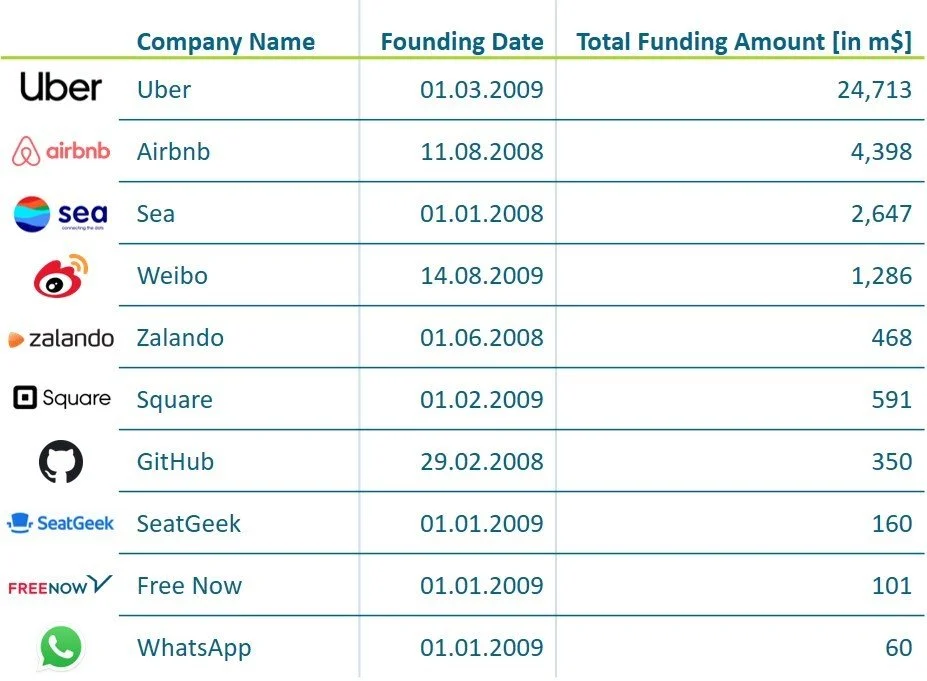
Selected ventures from vintages 2008 and 2009
For many successful start-ups of that era, the crisis was a two-edged sword. The economic recession made it difficult to secure investor funding, and customers' willingness to pay for innovative services dwindled. Nevertheless, the crisis-infused disruption in the market and employment conditions acted as a catalyst for many start-ups.
Take Airbnb and Uber as an example: the large spikes in unemployment and the need to save money at every corner such as transport or holiday provided these two companies with ideal market conditions for their business model. Customers were able to save money compared to traditional competitors' offerings, while drivers and hosts respectively could gain significant additional income. Similarly, WhatsApp enabled people to save money during a time where most people still paid per text message. Hence, these start-ups' success is not just a mere coincidence but a result of them addressing the economic needs elevated by the crisis.
Another critical factor has been the lean start-up approach based on customer focus and iterative, agile product development. It allowed start-ups to mitigate financial bottlenecks and advance their innovations very efficiently. This quality propelled the most successful start-ups on eye-level with or even beyond incumbents within just a decade.
So how can established organizations put on the rain tyres to emerge stronger from the crisis? We have compiled four lessons learned from our work. Apply them to your business like a set of rain tyres to gain traction and speed.
1) Cross-everything teams
Heterogenous, well-balanced teams deliver better results. When team members cover all the steps of the process or value chain, the solution has better chances of working end-to-end.
2) Agile development and design thinking
Beyond the buzz, those working practices centered around the customers and an iterative, hypothesis-, and data-driven project execution deliver a performance increase of at least 40%.
3) Staged funding
Overfunded projects tend never to find product-market-fit. Strictly staged funding linked to objectively measurable goals provides teams with focus. Initial funding should not cover more than three months runway, with periods rising to one year in later stages. Reporting on the operational KPIs should be available weekly.
4) Accountable ownership
One key reason for lean start-ups to thrive is the commitment of the management team. Established organizations cannot match the financial upside nor the daunting threats that venture founders face. But they can increase accountability, for instance by creating ownership in addition to the operational responsibility on a sponsor level and by frequent as well as transparent communications.
Extra tyre: Modern technology stack
A service-oriented architecture with micro-services loosely coupled by APIs is much more flexible than traditional set-ups. Add the partnering capabilities to quickly find the right partner for the development challenge at hand and technology becomes a booster instead of a drag.
This works for initiatives to increase efficiency as well as for new business projects. Look out to leverage your CDO organization or Digital Transformation teams, as they have ample experience with these practices.
Thanks to Marc Buchner and Conrad Bethge who contributed to this article.
The Limits of Robotic Process Automation
Why traditional RPA and ITSM tools often lead to "Ticket Purgatory" rather than autonomy. A case study on moving beyond brittle scripts to Machine Reasoning—using semantic ontologies to achieve a 90% automated resolution rate in complex IT environments.
Is your IT helpdesk drowning in tickets? Does incident handling consume your DevOps teams? Are you struggling with hiring IT specialists and bind them in the long term? Are you grappling with innumerable systems and tools, requiring niche skills and experiences from many years?
You are not alone. One CIO faced backlogs of more than 2,000 tickets, regular maintenance tickets were already ignored, and critical development milestones 1.5 months overdue. The situation further escalated as IFRS related incident and development tickets for specialized finance on-premise applications were piling up. The department concentrated on fast deployments of servers and “quick and dirty” fixes only exacerbating the problems going forward. This is outright ticket hell.
But many more IT departments are at least in what we call ticket purgatory. By harnessing all their strengths, IT tickets are processed within 24h hours. Still, the effort interferes with IT operations, especially in areas of development, maintenance, and IT’s participation in corporate missions, like the development of future business models.
Advanced ITSM tools like ServiceNow and Robotic Process Automation (RPA) do alleviate the problems but are not resolving them. The automation rates remain low because IT environments are mostly too complicated and are changing too fast for fixed automation approaches. In the meanwhile, maintenance requirements for the installed robots increase quickly, and quality issues appear on the horizon. Changed user interfaces after updates, swapped columns in relational databases, unknown error codes, and many other usual IT evolutions cause much trouble to fixed solutions.
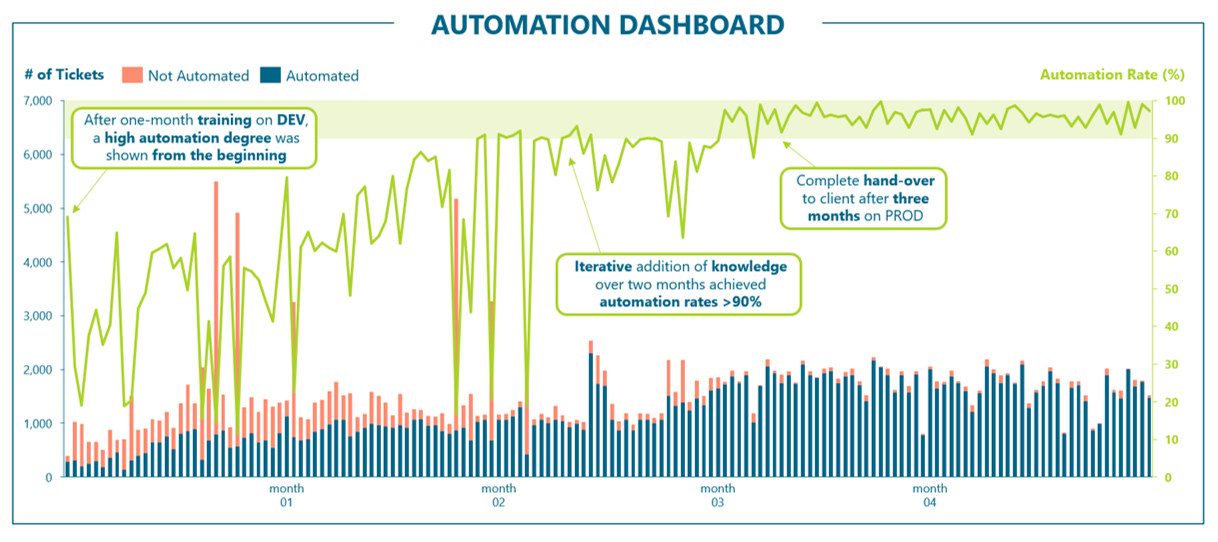
Automation Dashboard
The dashboard shows the impressive automation rate of more than 90% of all incident tickets delivered in just four months. Such results are achieved by applying Machine Reasoning that orchestrates existing ITSM and RPA tools or automates digital processes directly. In a first step, we create a representation of the real world. In this case, we used the MARS ontology (Machine, Application, Resource, Software) for describing the entities and their relationships, and imported the customer’s CMDB. In the second step, we build a knowledge repository based on our library that allows solving many standard tickets. In parallel, we adopt connectors and action handlers to the customer’s systems. Finally, we performed iterative functional testing and integration testing before production go-live after one month. While the average automation rate was already about 50% in the beginning, you can see spikes of manually solved tickets during the first couple of months. To address those ticket types and further increase the automation rate towards the 90% target, we continuously added knowledge items over three months. During this phase, designated members of the client organization were enabled to run the solution. The complete hand-over took place when more than 90% of all tickets were constantly solved automatically.
So what is it for you? Heaven or hell?
Thanks to my co-author Felix Hornung.
Artificial Intelligence: Success with 'Fail & Learn Fast'
Short article in today's special edition of Handelsblatt for the AI Summit regarding experiences in implementing AI initiatives using the 'Fail & Learn Fast' approach.
Short article in today's special edition of Handelsblatt for the AI Summit regarding experiences in implementing AI initiatives using the 'Fail & Learn Fast' approach.